Ten of Wands
Too many obligations are weighing on you; redistribute responsibilities before reaching a limit.
Explore its meaningA little clarity begins with a good question.
With this free online tarot, you can ask a question, choose your cards and explore a reading that helps you see your situation differently.
Begin my readingFree, no sign-up. You choose the cards.
Too many obligations are weighing on you; redistribute responsibilities before reaching a limit.
Explore its meaningThere is no perfect question. Start with what you want to understand today.
Not sure what to ask? Try one:
Typing a question is optional. On the next screen, you will shuffle and choose your cards.
Beyond a reading, discover your tarot birth cards and return to readings you have saved.
Discover the Major Arcana associated with your birth date and see each step of the calculation.
Discover my cardsRevisit the cards, questions and reflections you have chosen to save in this browser.
Open my readingsFind the readings that fit what you are going through.
You do not need to memorize tarot meanings or perform a ritual. This experience takes you from a question to a reading you can reflect on and compare with real life.
Ask about a relationship, work, or a decision. Type your question, pick an example, or simply keep it in mind.
On the next screen you will see the face-down deck. Shuffle and pick one, three, or five cards. Each position has a purpose.
Read what each card symbolizes and how they relate. Take what helps you reflect, and check it against the facts.
The Daily Card is shared by everyone. In a personal reading, you choose your own cards.
Start my readingImagine someone stopped texting you. A three-card spread cannot reveal what they are thinking. It can help you notice your uncertainty, the choice that feels difficult, and the next step within your control.

Uncertainty takes up space. What do you know, and what are you assuming?
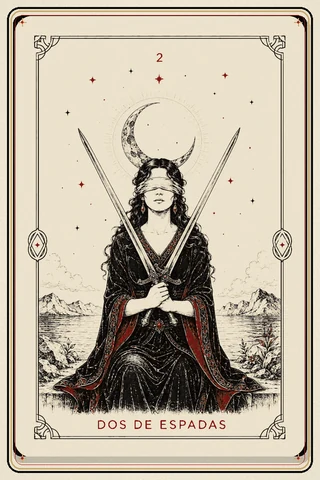
You feel caught between choices. What information or conversation is missing?
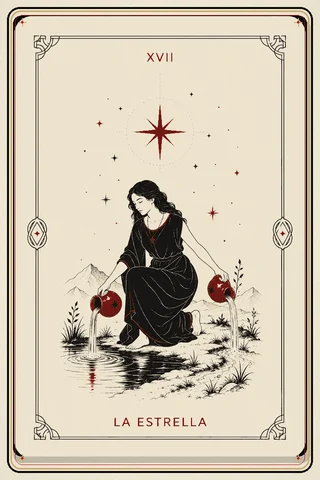
Regaining calm is progress, too. You do not need to settle everything today.
These cards are only an example of how to connect the symbols. Your own reading will use the cards you choose.
Try my own readingSometimes you do not know whether to wait, have a conversation, or move on. Tarot cannot reveal someone else’s thoughts. A reading can help you find words for your feelings and look at what is happening.
Explore love tarotA card can mean one thing alone and something different beside other cards or in another position. Learn the symbols and build your own interpretation.
Explore card meaningsThe reading is not built from one generic sentence. It combines your question, the cards you choose, each card position, orientation, and how the cards interact with one another.
This is a symbolic reading for personal reflection. It does not claim certainty about the future or another person’s private thoughts.
Before you begin, this is what the tool uses and where its limits are.
Different questions need different levels of context. Choose the spread for the job rather than adding cards just because more feels better.
| Spread | Cards | Best for |
|---|---|---|
| One card | 1 | A focused question or a single point to reflect on. |
| Yes or no | 1 | A genuinely closed question that can hold a brief nuanced answer. |
| Three cards | 3 | Situation, tension, and a possible direction. |
| Five cards | 5 | More context, obstacles, resources, and direction. |
Specific questions are easier to work with than vague requests for certainty. Instead of “Will everything be okay?”, try “What do I need to notice before making this decision?” or “What dynamic is shaping this relationship right now?”.
When asking about another person, keep observable behavior separate from assumptions. Tarot can help frame a symbolic reading of the situation, but it cannot verify someone else’s private thoughts.
These are starting points, not fixed formulas.
What dynamic is present between us right now, and what should I notice before acting?
What am I overlooking between these two options?
What factor is slowing my progress and what resource can I use?
Drawing again until you get the answer you wanted usually adds noise rather than clarity.
Position, orientation, and the surrounding cards all change nuance.
Tarot is symbolic. A favorable card does not turn a hope into a verified outcome.
If the cards and the facts seem to conflict, the facts still matter.
A reading becomes useful when you connect the symbols to something you can actually observe or decide.
The deck choice is part of the reading rather than a decorative animation.
The wording defines the context.
The positions decide what each card is asked to do.
You browse all 78 face-down cards and choose your own.
Each card is interpreted inside its assigned role.
The reading compares agreement, tension and repetition across the spread.
A card starts with its core meaning, then changes nuance according to position and orientation. An expansive card in a “resource” position may show something available to use; the same energy in a “block” position can point to excess or poor direction.
Reversals are not automatically negative. They can indicate delay, blockage, internalization, exaggeration, or difficulty expressing the card directly.
Tarot can help you organize a question, notice a pattern, and turn a vague feeling into something you can observe or act on. It cannot verify future events, private thoughts, or information that should come from documents, conversations, or qualified professionals.
When symbolic interpretation conflicts with concrete evidence, the evidence should carry more weight.
Do not force every sentence to match.
Return to its position: it may be describing the block rather than the outcome.
That may describe a real split between desire and behavior, opportunity and structure, or feeling and decision.
Turn the reading into a practical question: what information, boundary, or conversation is missing?
Use the next page to answer the next question, not to repeat the same one.
No. You can ask a question and draw cards without creating an account.
Use one for quick focus, three for context and five for a deeper reading.
Yes, but the reading is symbolic and cannot know another person’s private thoughts with certainty.
Not immediately. Repeating the same question often creates more confusion.
No. Repeating the same question without new context usually adds noise and confirmation bias. Draw again when new information appears or the question genuinely changes.
No. It can indicate blockage, excess, delay, or a more internal expression. Position and surrounding cards determine the nuance.